

Client Onboarding Procedure

Independent Advice Ltd, trading as H.J. Scott & Co — Document ref. [[document reference]] — Effective date [[effective date]]

Document Control

Version Date Author / reviewer Summary of changes
1.0 [[date]] Howard Scott (SMF16) First house-style Client Onboarding Procedure, built out from the firm's working onboarding notes (four meetings: Initial Discovery, Risk & Platform, Solution, Bedding-in). Retains the original approach and stages in full. Adds explicit tagging of each stage against the Consumer Duty's four outcomes and three cross-cutting obligations, and adds the underlying FCA Handbook / MLR 2017 references throughout. This document is the fuller companion to the brief "Client Onboarding Process" paragraph in the Compliance Plan, and should be read alongside the Client Journey Map, Vulnerable Persons Policy, Consumer Duty Governing Body Report and Data Security Risk Assessment.

Owner: Howard Scott, SMF16 (Compliance Oversight). Next review due: [[next review date]], or sooner following any material change to the onboarding process, the firm's target market, or relevant FCA rules.

Drafting note: this document is built from Howard's working onboarding notes, expanded to house style. The four meetings, their content and sequence are unchanged. This document should be checked by Howard against actual practice, then reviewed by Gareth Johnson before adoption, consistent with the firm's practice for other significant compliance documents.

Our Approach

We provide a bespoke, individual service to our clients. We do not operate a transactional business. There is no "one size fits all" approach. We aim for long-term client relationships. We tailor our client service to suit their needs and aim for good client outcomes. We strive for high levels of client satisfaction on a daily basis.

This approach is the practical expression of our obligations under the Consumer Duty's cross-cutting obligations (PRIN 2A.2, FCA Handbook) to act in good faith, avoid causing foreseeable harm, and enable our clients to pursue their financial objectives — and of the four retail customer outcomes set out below, which this procedure is deliberately structured around.

1. The Consumer Duty: Cross-Cutting Obligations and Four Outcomes

Every stage of onboarding is designed with the following in mind. Each meeting below is tagged against the outcome(s) it most directly supports, so that the connection between what we actually do and our regulatory obligations is visible throughout, not just asserted at the front of the document.

1.1 Cross-cutting obligations

Obligation What it means in onboarding Reference
Act in good faith Open, honest engagement from the first triage conversation; no hard sell; clients are given time and space to decide whether to proceed. PRIN 2A.2.2R
Avoid causing foreseeable harm Vulnerabilities are identified and taken into account from the very first meeting; clients who are not a fit for our model and target market are declined, elegantly, rather than onboarded regardless. PRIN 2A.2.3R; Vulnerable Persons Policy
Enable customers to pursue their financial objectives The whole process — from discovery through to the bedding-in meeting — is built around understanding, and then meeting, what the client is actually trying to achieve ("Clouds and Pavements"). PRIN 2A.2.4R

1.2 The four outcomes

Outcome What it means in onboarding Reference
Products and services We only take on clients who are a good fit for our discretionary management proposition and target market; the target market assessment starts at the triage meeting, not after the client has signed up. PROD 3.2 – 3.3
Price and value Costs and charges are disclosed clearly, in writing, before any commitment is made, via the Client Agreement, Disclosure document and Key Features Document/illustration. COBS 6.1ZA; COBS 13 & 14
Consumer understanding Communications are tested for understanding at every stage — the platform is explained and demonstrated before the client uses it, and the bedding-in meeting exists specifically to check understanding has actually landed. PRIN 2A.4
Consumer support Support does not stop at the point of sale: the bedding-in meeting, ongoing platform access help, and Howard's blogs are all deliberate, planned continuations of support after onboarding completes. PRIN 2A.5

The firm's overall approach to monitoring these outcomes, and reporting on them annually, is set out in the Compliance Plan's Consumer Duty section and the Consumer Duty Governing Body Report.

2. Initial Discovery Meeting

Products & ServicesConsumer Support

3. Second Meeting: Risk & Platform

Price & ValueConsumer UnderstandingProducts & Services

4. Solution Meeting

Price & ValueConsumer UnderstandingProducts & Services

5. "Bedding-In" Meeting (approximately 3 months after completion)

Consumer SupportConsumer Understanding

The client is invited to a further meeting once investments have settled, to ensure:

This meeting is the point at which we test, directly with the client, whether the products and services outcome, the price and value outcome and the consumer understanding outcome have actually been achieved in practice — not just documented as intended at the point of sale. Any gap identified here feeds into the firm's annual Consumer Duty outcomes monitoring.

6. Record Keeping

Records generated at each stage of this procedure are retained in accordance with the retention periods set out in the Compliance Plan's Record Keeping – Data Security – GDPR section and the Data Security Risk Assessment COBS 9.5.7R; SYSC 9. Filing follows the firm's standard split between the CRM and the client's cloud file:

Record type Where filed
Meeting notes taken at each stage (Discovery, Risk & Platform, Solution, Bedding-in), including Attitude to Risk discussion, aims, and "Clouds and Pavements" notes Transposed into the fact-find section of the firm's CRM
Original client documents – e.g. ID copies, and any other original documents taken during onboarding Held against the client's file in Apple iCloud

This is consistent with the data inventory in the Data Security Risk Assessment, Section 1, which records client identity, contact and financial-planning data as held across the website/WordPress database and Apple iCloud.

7. Related Documents

This procedure should be read alongside the Client Journey Map, the Compliance Plan (Client Onboarding Process and Consumer Duty sections), the Vulnerable Persons Policy, the Consumer Duty Governing Body Report, and the Data Security Risk Assessment.

June 2025 Performance Review

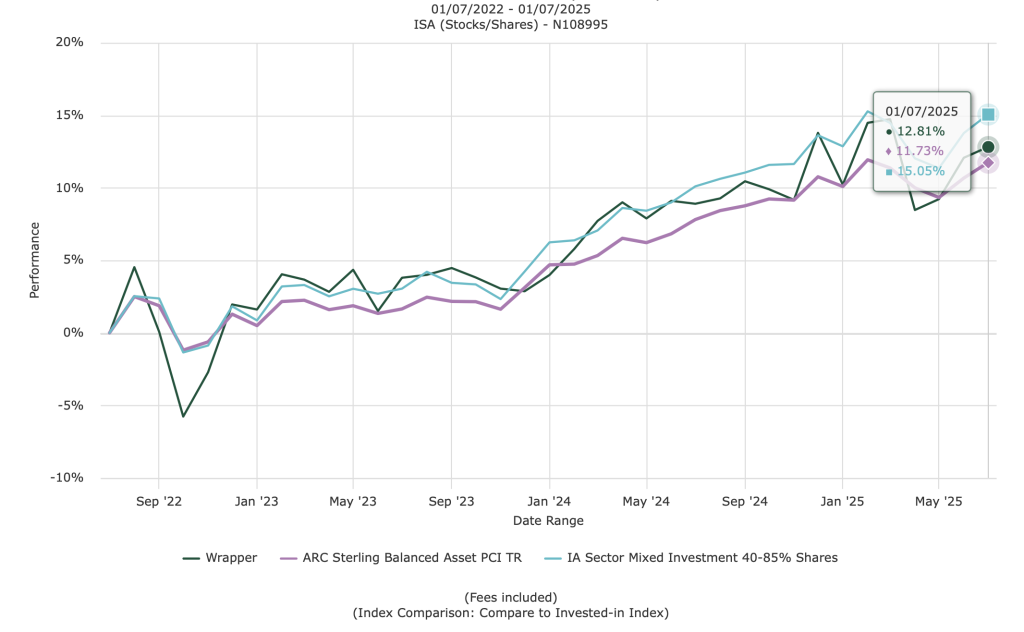
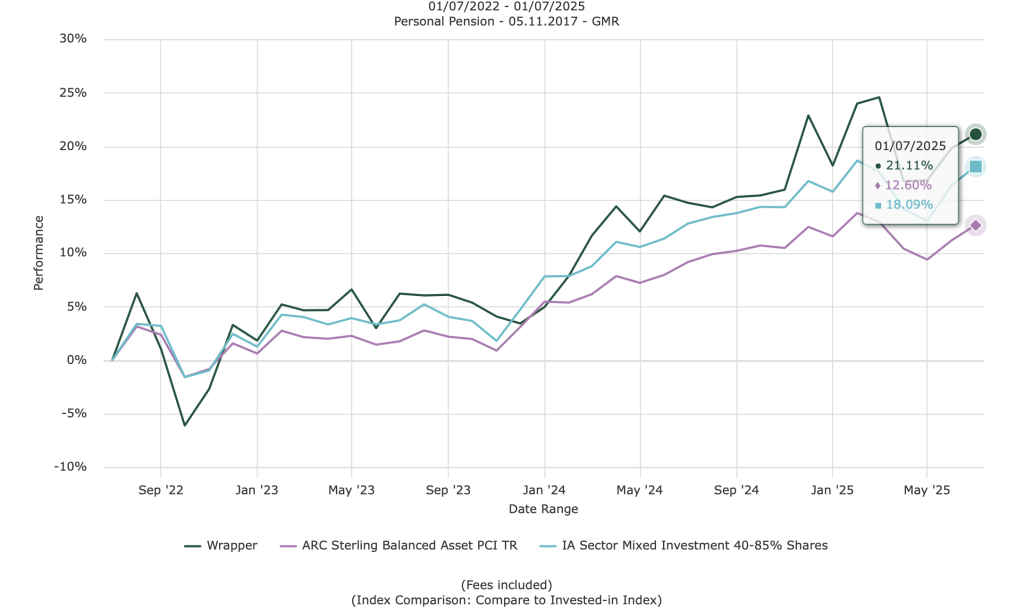
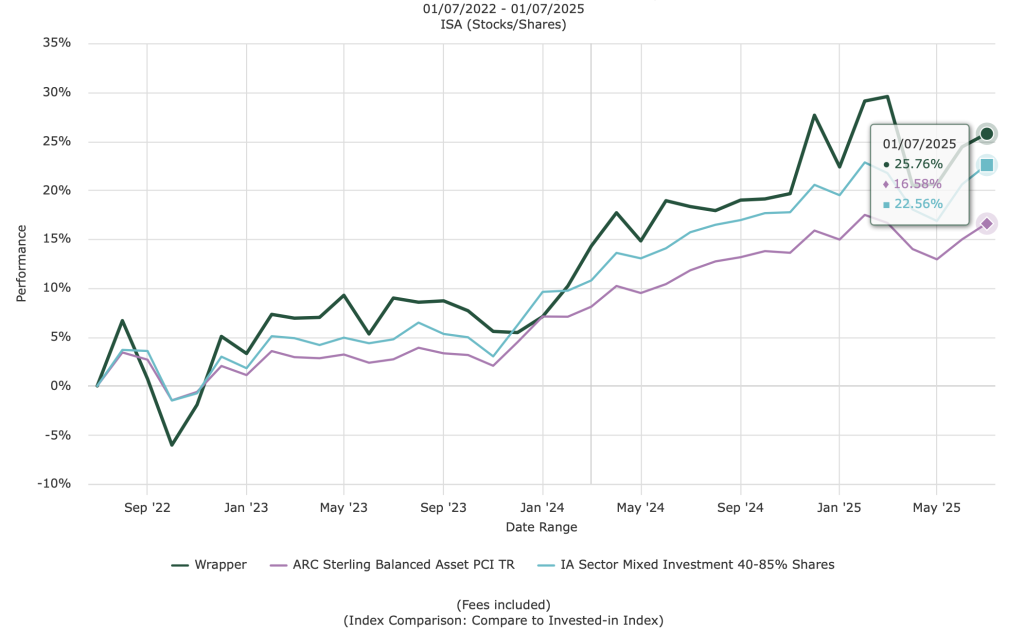
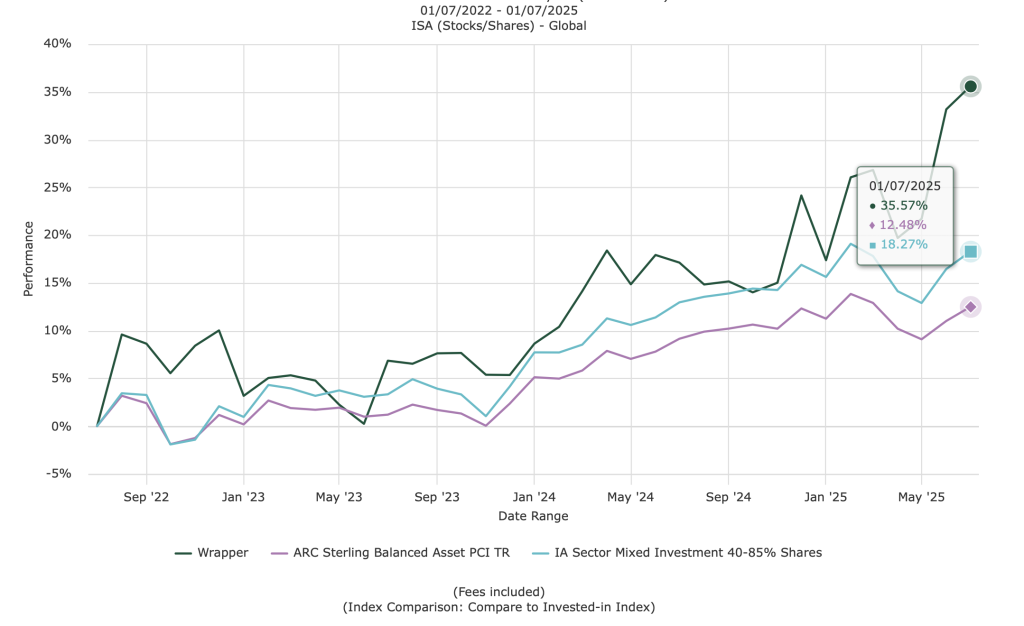
We first began moving clients from Nucleus to Transact late 2021. So we can now show our performance versus our industry peer group across our portfolios for a full standard 3 year period.

In all of the charts below, each of our managed portfolios are shown by the bold green line. Our peers performance is shown in blue and purple lines.

Our Cautious Portfolio

Our Moderate Portfolio

Our Aggressive Portfolio

Our Very Aggressive Portfolio

Each of the charts above are actual client portfolios.

We continue to out-perform our peer groups in all portfolios. Our Cautious Managed Portfolio unfortunately is not a fair comparison versus its peer group as care home fees of several thousand pounds are withdrawn each month for the client in question. This reducing balance has blunted the true performance somewhat.

Charlie and I are happy with our achievements so far. The Transact platform has given us a huge investment universe of direct equities to choose from, with very reasonable custody, currency and trading costs.

The above performance is net of our fees, trading fees and Transact fees.

We remain dedicated to looking after your, and our, life savings.

If you have any questions don’t hesitate to ask. After all, unlike your friends and acquaintances, you can talk to the investment managers who look after your savings in person.

Obviously I have to say at this point………..Past performance isn’t necessarily a guide to the future.

What is Money?

Have you ever wondered; 

  • What is money anyway? 
  • Why do we trust money?
  • What’s that five pound note in your pocket really worth? 
  • Where does money come from and where does it go?

I’m guessing the answer is probably not. Money is just an everyday thing.  It’s there, we just spend it or save it.

Our own currency that we spend everyday is taken for granted, except when we travel and it’s no longer accepted as currency. Why is it even called currency?  Well the answer to the last question is indeed predictable. It’s the current value of our money versus other countries money. Which in itself begs the questions; 

  • What was our money worth previously? 
  • Was it worth more or less?

To answer these questions we need to go back a long way in time. To a time before money existed. 

Sapiens

I have read some very influential books in my time. Very few have been works of fiction. I’m intellectually poorer for that I guess. My Northern upbringing of seeking “value for money” has directed me solely to books I can learn from. One such book is Sapiens – A brief history of mankind by Yuval Noah Harare. Before reading this book I believed the Agricultural Revolution was the time before tractors. But no. The agricultural revolution was the time when primitive humans ceased to be hunter-gatherers and became the farmers of crops and livestock. Who knew? That transition changed everything. Prior to farming, life was free, but probably not easy.  Food was collected as needed, a free for all endless all you can find buffet. Once all the food was taken from one area, individuals moved on. A truly nomadic experience. Nobody was a landowner, primitive tools were the only possessions, used to dig for roots perhaps. Recent Bill Gates funded research wouldn’t have been needed back then, like today’s Aborigines, we would be happy obtaining protein from grubs. 

Continue reading “What is Money?”

Turn off the news

“I’ve been saying this since the 2009 Financial Crisis, and I’ll say it again today:

Turn off the news.

Back then, I was glued to the financial media. I’d watch the major networks, read the papers, soak up the headlines. I thought I was doing my job as an investment manager by being informed.

But all anyone did on TV was scream at each other. The newspapers were filled with terrifying headlines designed to make you panic — and usually trick you into doing something stupid with your money.

So I stopped.

I stopped letting the fear machine into my head. I stopped investing based on other people’s emotions. I decided to let the market tell me what was happening — not the suits on TV or the clickbait headlines.

Fast forward to today. I’m seeing people on social media flipping out about geopolitical developments, bombs dropping, oil surging, and the stock market “about to crash.”

The U.S. dropped some bombs this weekend and the fear juices are flowing.

I get it. The world feels shaky sometimes.

But when those feelings rise up, I take a breath… and I go look at the charts.

Because here’s the truth: the market is the news.

Continue reading “Turn off the news”